Notice To all Customers:

As part of our commitment to provide the highest quality customer service we are upgrading our customer information systems beginning Friday June 28, 2019 at 4pm. The new system will improve our service and system reliability to you.

The upgrade will impact the availability of some of our self service functions in eCare, and our IVR system. Services not available during this migration are:
• Access to your online account
• Automated balance and payment history inquires through our phone system
• Time of Use Graphs will not populate

Upgrade Time Frame


Start: Friday June 28, 2019 at 4pm EST
Finish: Tuesday July 2, 2019 at 8:30am EST


We appreciate your patience during our technology upgrade and we look forward to continuing to service you in the future.

If you need to make a credit card please visit this website.

Have a safe and enjoyable long weekend. Happy Canada Day!

June 24, 2019 – OSHAWA – Oshawa Power held their annual general meeting on June 13, 2019. In attendance were Oshawa Power staff, board members, Oshawa city and regional Councillors, City of Oshawa staff, and Mayor Dan Carter.

“We are Oshawa Power” was the ongoing theme throughout the 2018 summary. Oshawa Power proudly displayed their accomplishments in the community, innovation, reliability, customer service and growth areas.

“Every day, Oshawa Power goes the extra mile to safely and reliably deliver electricity and energy-related services; provide the lowest residential distribution rates for power in Durham Region; grow the value of our company; and maintain a steady stream of revenue that our shareholder, the City of  Oshawa (the City), uses in delivering the services and infrastructure that make Oshawa a vibrant community.” Quoted from the annual report.

Oshawa Power declared an annual dividend payment for the City of Oshawa of $2.5 million, an increase from 2017’s $2.3 million.  An outstanding accomplishment considering recent government and regulatory changes. Oshawa Power is committed to maintaining its excellence customer service, exceptional value, and to continue being a truly great company.

Oshawa Power invites you to read their 2018 annual report and AGM Presentation 2019.

If you have any inquiries please reach out to Sheila Risorto 905-723-4626 extension 5243 or srisorto@opuc.on.ca.


SCAM ALERT! We have received reports from our customers that they have received calls from 1-800-948-5608 and the company represents themselves as Oshawa Power demanding payment.

This is NOT us – Oshawa Power does not have a 1-800 number. Do not engage with this company. Do NOT provide any personal information. If you are in doubt please call us at 905-723-4623.

If you receive this type of call please notify Durham Regional Police at 1-888-579-1520 or the Canadian Anti – Fraud Centre 1-888-495-8501 .

Click here for Oshawa Power’s 2018 OEB Scorecard

Ahead of their Annual General Meeting scheduled for June 13, 2019 Oshawa Power has released their 2018 results for key performance indicators. Oshawa Power strives to continuously excel at meeting their customers’ needs efficiently and accurately. Below is a high level summary of some customer service, public safety and financial health metrics.
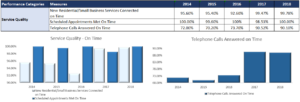
New Residential/Small Business Services Connected on Time – In 2018, Oshawa Power connected 99.78% of low-voltage residential and small business customers (those utilizing connections under 750 volts) to its system within the five-day timeline prescribed by the OEB. The industry target is 90%.

Scheduled Appointments Met On Time – Oshawa Power schedules appointments to complete work requested by its customers. OPUCN met 100% of these appointments on time, which significantly exceeds the industry target of 90%.

Telephone Calls Answered On Time – Customer Service representative answered telephone calls within 30 seconds 90.1% of the time. This result exceeds the OEB-mandated 65% target for timely response. OPUCN offers customers 24/7 service through various online forms and interactive voice response tools. This allows us to address the most common customer inquiries and service needs cost-effectively without compromising quality or service excellence.
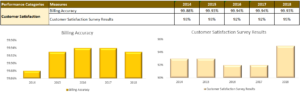
Billing Accuracy – For 2018 Oshawa Power achieved a bill accuracy measure of 99.93%. This compares favorably to the prescribed OEB target of 98%.

Customer Satisfaction Survey Results – In 2018, Oshawa Power engaged Simul Corporation to conduct a customer satisfaction survey. The findings from the annual survey results are utilized to make enhancements in processes, services and communications strategies throughout the organization. 95% of OPUCN’s customers rated their experience with Oshawa Power as fairly satisfied to very satisfied.

Public Awareness of Electrical Safety – Public Awareness of Electrical Safety, measures the level of awareness of key electrical safety precautions among the public within the electricity distributor’s service territory, and the degree of effectiveness for distributors’ activities on preventing electrical accidents. The OEB requested that all LDCs carry out a survey using the Electrical Safety Authority’s (ESA) approved methodology and pre-formed set of questions, so that a final LDC Awareness Score (bound between 0-100%) can be calculated. The survey resulted in Oshawa Power’s public awareness index score of 85%. In 2018, Oshawa Power has further engaged the public in health and safety awareness by: producing a Hazard Hamlet demonstration during a customer care event; displaying health and safety posters geared towards the six awareness areas of the Electrical Safety survey; and, incorporating a new health and safety webpage on our website.

Serious Electrical Incident Index – Oshawa Power reported no fatalities or other serious incidents due to contact with its infrastructure in 2018, thereby achieving a score of 0.000 for the Serious Electrical Incident Index per 1,000 km of line. Oshawa Power takes public safety in the vicinity of its distribution equipment very seriously, and regularly carries out activities to take prompt corrective action where potential public safety issues are identified.
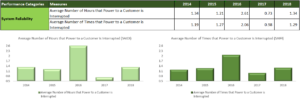
Average Number of Hours that Power to a Customer is Interrupted – Oshawa Power’s reported Average Number of Hours that Power to a Customer is Interrupted (i.e., duration excluding loss of supply) is 1.34 hours per customer.

Average Number of Times that Power to a Customer is Interrupted – Oshawa Power’s reported Average Number of Times that Power to a Customer is Interrupted (i.e., frequency excluding loss of supply) for 2018 is 1.29. times per customer.
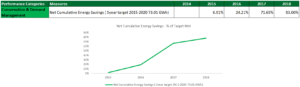
Conservation and Demand Management – Under the 2015 to 2020 Conservation First Framework, Oshawa Power was assigned an energy savings target of 73 GWh. The achievement of this energy efficiency target is governed via an Energy Conservation Agreement (ECA). The IESO periodically issues updates to the ECA and Oshawa Power regularly commits to the updated terms. Oshawa Power’s net cumulative total energy savings for the CFF as of December 31, 2018 is 59.14 GWh, or 81% of the multi-year target. At the half-way point in the framework, Oshawa Power is well-positioned to achieve or exceed our 2020 conservation targets.
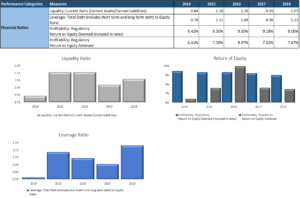
Liquidity: Current Ratio (Current Assets/Current Liabilities) – The current ratio is an indicator of a company’s ability to repay its short term debts and financial obligations. Companies with a ratio of greater than 1 are often referred to as being “liquid”. Generally, the higher the number, the more “liquid” and the larger the margin of safety to cover the company’s short-term debts and financial obligations. Oshawa Power’s current ratio for 2018 is 1.07. Oshawa Power monitors and manages its liquidity risk to ensure access to sufficient funds to meet operational and investing requirements.

Leverage: Total Debt (includes short-term and long-term debt) to Equity Ratio – The OEB uses a deemed capital structure of 60% debt, 40% equity for electricity distributors when establishing rates. This deemed capital mix is equal to a debt to equity ratio of 1.5 (60/40). A debt to equity ratio of more than 1.5 indicates that a distributor is more highly levered than the deemed capital structure. A high debt to equity ratio may indicate that an electricity distributor may have difficulty generating sufficient cash flows to make its debt payments. A debt to equity ratio of less than 1.5 indicates that the distributor is less levered than the deemed capital structure. Oshawa Power’s debt to equity ratio for 2018 was 1.21. Oshawa Power continues to be below the OEB’s deemed capital structure, as the trend from 2013 to 2018 illustrates a debt to equity ratio of less than 1.5.

Profitability: Regulatory Return on Equity – Deemed (included in rates) Oshawa Power’s current distribution rates were approved by the OEB and include an expected regulatory return on equity (ROE) of 9.19%, which is based on the OEB’s deemed capital structure of 60% debt and 40% equity as noted earlier. The OEB allows a distributor to earn within +/- 3% of the expected return on equity. When a distributor performs outside of this range, the actual performance may trigger a regulatory review of the distributor’s revenues and costs structure by the OEB. The regulated return for the year 2018 decreases to 9.00%.

Profitability: Regulatory Return on Equity – Achieved Oshawa Power’s ROE for 2018 was 7.47%, compared with a regulatory ROE of 9.00% for the same period. For 2018, OPUCN earned a lower return than the approved rate, however; results are within the expected ROE set out by the OEB.

NOTE TO READERS: THE ABOVE RESULTS ARE PRELIMINARY AND VERIFIED INTERNALLY BY OSHAWA POWER STAFF AND HAVE NOT BEEN SUBJECT TO AN AUDIT PROCESS. OFFICIAL RESULTS WILL BE PUBLISHED ON THE OEB WEBSITE IN SEPTEMBER.

Oshawa Power 2018 Results

Respect the Power: Powerline Safety Awareness Week

May 11-17, 2019 urges Ontarians to be mindful of powerlines

Powerline Safety Awareness Week in Ontario is a time to be reminded of the importance of staying clear of overhead and underground powerlines, particularly when working, doing household chores or having fun outside.

Tragically every year people in Ontario are killed or critically injured from contact with powerlines and electrical utility equipment,” said Scott Saint, ESA’s Chief Public Safety Officer. “We need everyone to recognize and respect the power and take some simple, yet life-saving safety precautions.”

“As the Victoria Day long weekend approaches, I urge all Ontarians to take a moment to increase their own and their family’s powerline safety knowledge,” said David Orazietti, Minister of Government and Consumer Services. “Taking the time to learn more now can prevent a tragedy later.”

Five Ways to Respect the Power

    1. Locate the lines. Before starting any outdoor job whether at work or at home, first look up, look out and locate. Then keep track of where they are as you move around so you’re always mindful of the powerlines.
    2. Keep yourself and equipment a safe distance away. For the kind of powerlines that connect a house to the poles on the street, keep yourself and any equipment (ladders, pruners, tall vehicles, etc.) at least one metre away.  For the higher voltage lines that run down streets, stay at least three metres away.  Not only is making contact very dangerous but even coming close to the line can cause the electricity to jump or ‘arc’ through the air and contact you or your equipment.
    3. Never attach or drape anything on a powerline. Never brace a ladder against a line or near its point of contact to a building. Don’t run other lines like antennas or cables on or near powerlines. And never grab a line for balance when working at heights.
    4. <Carry equipment horizontally. Carry ladders, pruners and other long equipment on their side, not vertically as they could connect or attract arcing from an overhead line.
    5. Plant trees away from overhead powerlines. If your trees have grown into or close to powerlines, contact your local utility. Do not trim trees around powerlines yourself. And call before you dig to ensure underground cables and other utility equipment are located and marked.

    For more tree trimming and landscaping tips, visit esasafe.com.

    Test your Electrical Safety Knowledge with the below Myths& Facts:

    MYTH:  I’m just trimming tree limbs, I won’t be using a ladder so I don’t need to worry.

    FACT:   Anything that touches a powerline – a pruning tool, the tree limb or your hand can give you a shock, burn or kill you. Better idea: call an arborist or your local electric utility and have one of their trained arborists trim the tree for you safely.

    MYTH:  I’m just digging a couple of feet into the ground. I don’t need to worry about underground lines.

    FACT:  The lines may be closer than you think or a grading change may have occurred over time. Better to be safe than sorry. Call before you dig — it’s the law! Call Ontario One Call to get a cable locate.

    MYTH:  If a powerline falls on my car, I should get out and run to safety right away.

    FACT:  The car and the ground around it may be electrified and you could be killed if you get out of the vehicle. Stay inside until the utility workers tell you it’s safe to get out. Tell everyone to stay back 10 metres or 33 feet.

    MYTH:  To get a shock or burn, I need to actually touch a powerline.

    FACT:  Just getting too close could cause you to receive a severe shock, burn or even kill you. Electricity can jump or ‘arc’ through the air to you or an object that gets too close. Always stay at least three metres or 10 feet away from powerlines.

    MYTH:  I can use a wooden stick to prop up a powerline or to knock down a toy that’s tangled in a powerline.

    FACT:  Even wood can conduct electricity. Never touch or come close to a powerline. Contact your local utility if you need assistance.

    MYTH:  A powerline that’s been knocked down doesn’t have electricity flowing through it, so it’s safe to be near it or move it out of the way.

    FACT:  Always assume a downed powerline still has electricity flowing through it, even if it isn’t sparking. Stay back at least 10 metres or 33 feet (that’s about the length of a school bus), call 911 and the local utility.

    For more Myths & Facts & other Powerline Safety connect to the following:

    https://www.esasafe.com/consumers/safety-and-security/powerline-safety/myths-and-facts

    https://www.esasafe.com/business/powerline-safety/

    How dangerous are overhead power lines? – Lucky the Squirrel learns the hard way how dangerous overhead power lines can be, in the below link to ESA’s video.

    #RespectThePower #PowerlineSafetyWeek


This Saturday May 4, 11 AM- 3 PM Oshawa Power will be at the McLaughlin branch of Oshawa Public Library with a fun interactive booth that will include our Hazard Hamlet, public safety handouts including a handy vehicle safety infographic to keep in your car, financial assistance brochures and giveaways!

So come on by and meet some Oshawa Power staff and learn about powerline safety!
McL-FAM-JUN11

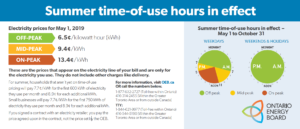
The Ontario Energy Board (OEB) announced there will be little change to electricity prices on May 1, and that summer time-of-use (TOU) hours come into effect.

Customers who pay tiered prices will see no change to their electricity prices, but the tier threshold that applies in the summer period will come into effect on May 1.

For residential and small business customers that buy their electricity from their utility, the new TOU prices set by the OEB for May 1, 2019 under the Regulated Price Plan (RPP) are shown in the table below. The table also shows the hours to which those prices apply.

On March 22, 2019, the Ontario government introduced changes to the approach the OEB is required to follow when setting RPP prices for the May 1, 2019 to October 31, 2019 period. The revised regulation requires that prices are set so that the monthly bill for a proxy customer increases by the rate of inflation relative to the bill on May 1, 2018.

The proxy customer’s bill is determined by calculating a weighted average of provincewide delivery and regulatory charges, assuming consumption of 700 kWh/month and a TOU usage profile of 65% used in off-peak, 17% in mid-peak and 18% in on-peak. The new RPP prices will mean a monthly total bill increase of $1.63 for the proxy customer.

For more information please visit the OEB website.

The new RPP prices will be in effect until October 31, 2019.

Oshawa Area Telephone Soliciting

Oshawa Power has received reports in our Customer Service department that some local customers have received fraudulent phone calls claiming to be calling from Oshawa Power.  The calls are from a 1-800 number and a representative threatens disconnection unless payment is completed by credit card.

Oshawa Power can confirm that we are not executing any outbound phone calls to our customers at this time and this third party is misrepresenting themselves.

If you have any question please do not hesitate to contact us at 905-723-4623 or emailing us here .

FOR IMMEDIATE RELEASE

February 24, 2019

Oshawa, ON – Oshawa Power’s electricity supply may be impacted due to extreme gusts of wind at 90 km/h up to 110 km/h expected later today. It is anticipated that power interruptions will occur due to the severity of current weather conditions. Please be advised that Oshawa Power is available and ready to ensure public safety however the severe winds pose a safety risk to our workers and will challenge our efforts to restore power quickly. Our trained responders will make every effort to restore power safely and as quickly as possible.

Harsh gusts of wind impact your power as they can damage power lines and/or cause their surrounding environment damage. Exposure to high winds can weaken trees, which can fall on top of powerlines temporarily suspending power.

Please take caution if you see a fallen tree limb or fallen powerlines. Downed powerlines may be energized and are dangerous. If powerlines are down, assume they are active and stay at least 10 metres away (the length of a school bus), and call 911 immediately. To report outages, Oshawa Power customers should call 905-723-4623.

If you identify a potential tree hazard that needs to be addressed please contact us using our message form, https://www.oshawapower.ca/contact-us/ and provide us with details. We will send out a crew to address the potential hazard.

Oshawa Power reminds customers to be prepared for power outages before the power goes out. The City of Oshawa and local emergency responders recommend that residents prepare and plan to be self-sufficient for 72 hours in an emergency situation.

  • Please make sure that you have flashlights and batteries available.
  • Do not use charcoal or a gas barbecue, camping heating equipment or portage generators indoors as they produce deadly carbon monoxide gas.
  • Before you leave home, please do walkthrough of your home just as you would when going on vacation and make sure all appliances are turned off such as stoves, ovens, coffeemakers, etc.

If you experience an outage, follow the updates on Twitter and Facebook, @oshawapower. To view a live update of current outages, visit the outage map at https://www.oshawapower.ca/outages.

This storm is expected to continue into the Monday morning commute and Oshawa Power would like to caution drivers to be aware of our crews on the road and be safe.

About Oshawa Power: Oshawa Power provides safe, reliable and efficient electricity distribution services to over 58,000 customers in the City of Oshawa. For more information visit www.oshawapower.ca.

Officials from the Japanese Consulate and the New Energy and Industrial Technology Development Organization of Japan (N.E.D.O.) visited Oshawa City Hall on February 19 as part of a wrap up of the international partnership component of their Solar Energy Management System pilot.

Led by Oshawa Power (Oshawa PUC), the five-year pilot project consisted of a unique partnership between the utility, City of Oshawa, Tabuchi Electric, and N.E.D.O., a Japanese governmental organization that promotes research in the renewable energy field.

The $1.2 million initiative involved the participation of 30 homes in Oshawa utilizing solar energy, an advanced smart inverter and a lithium-ion battery to simultaneously produce, store and manage energy from their own home.

The 30 households were each provided with an energy storage system to store solar power for use during peak hours and after sunset. The systems also provided several hours of backup power in the event of an outage. Additionally, the homeowners realized savings of over 50 percent on their electricity bills.

The pilot demonstrated and quantified beneficial climate change adaptation strategies, as well as benefits to both the consumer and the utility such as virtual power plant functions.

Prior to the project kick-off in 2014, a project of this scale and scope had not yet taken place in North America.

The February 19 visit included:

  • a closing results forum with officials and staff representing all the project partners and many participating pilot homeowners
  • a meet and greet and gift exchange with members of City Council, Oshawa Power, the Japanese Consulate and NEDO
  • Oshawa Power presentation of the high-level results during the regular City Council meeting

Detailed results from the pilot will be posted on Oshawa Power’s website in the coming weeks.

Oshawa Power provides safe, reliable and efficient electricity distribution services to over 58,000 customers in Oshawa.

Quotes:

“Oshawa Power is proud to have collaborated with major international partners and the City of Oshawa to bring leading-edge technology to our customers. This award-winning pilot brought international notoriety and roughly $1.2 million dollars of investment to our community,” said Ivano Labricciosa, President & CEO, Oshawa Power. “Through the joint efforts of the partners, we explored new service offerings that promote affordability, reduce environmental impact and increase the resiliency of our power system – all things we know are important to the people of Oshawa.”

“This international partnership and cutting-edge residential solar storage pilot – the first of its kind to launch in North America five years ago – was another great example of Oshawa being on the leading edge of innovation,” said Oshawa Mayor Dan Carter. “We thank Oshawa Power and our partners from Japan, Tabuchi Electric and N.E.D.O. for investing in our city and making advancements in the renewable energy field.”